7 April 2026 · 9 min read
Boa Vista Property Guide: What Buyers Need to Know in 2026
Boa Vista Islands Guide
Last updated: April 2026
Boa Vista is Cape Verde's second major tourism island and its second most active property market. It's often positioned as the growth alternative to Sal — lower entry prices, developing infrastructure, and the suggestion that it is today where Sal was a decade ago. That framing is partially accurate and partially marketing. This guide separates the two.
Island Overview
Boa Vista is the third largest island in Cape Verde by area and has its own international airport — Aristides Pereira International Airport, near Rabil — with European routes that are seasonal and best checked against current airport and airline schedules. It is a large, sparsely populated island, with the resident population concentrated in the main town of Sal Rei; for the precise census figure and reference year, consult the Instituto Nacional de Estatística (INE).
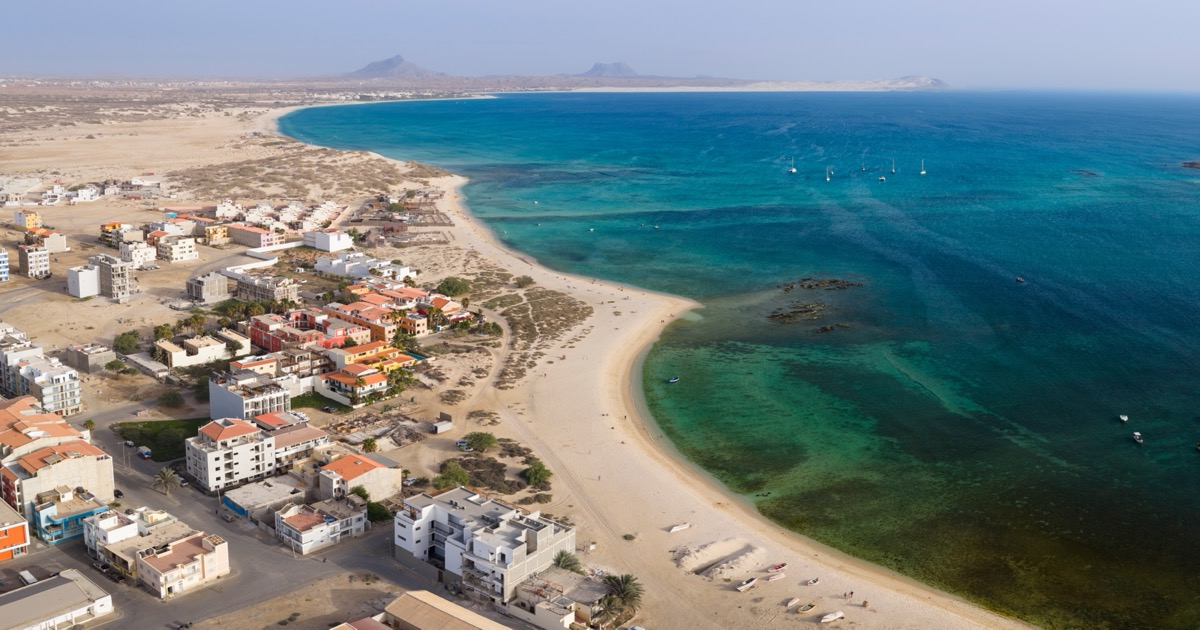
The island is characterized by wide, largely empty beaches, extensive sand dunes, and a flat, semi-arid interior. The natural landscape is one of its strongest assets — several beaches are among the finest in the archipelago — but the infrastructure outside resort zones remains limited relative to Sal.
Tourism is the primary economic driver. Outside the resort areas, the local economy is small and services are limited. This context matters for buyers assessing the island for either residential use or investment.
Key Areas for Property Buyers
Sal Rei
The main town and commercial center of Boa Vista. Sal Rei has the island's most functional daily infrastructure — a market, restaurants, banks, pharmacies, and municipal services. It sits on the western coast and has a waterfront with sea views.
Property in Sal Rei is a mix of local residential housing, colonial-era buildings (some with renovation potential), and newer development. It's the most livable option for buyers who want to actually use the island as a base rather than purely as an investment. Prices are generally lower than comparable properties in resort complexes.
Northern Resort Zone (Chave Beach area)
The primary concentration of resort developments is in the north of the island, centered around Praia de Chave — a long, undeveloped beach consistently rated as one of Cape Verde's finest. Several large resort and hotel-apartment complexes have been built here or are under development.
This is where most foreign investor activity is concentrated. Properties are predominantly apartments and hotel units within managed complexes, with the associated rental scheme model. Prices and availability vary significantly by development, age, and quality.
Santa Monica and Southeast
The southeast of the island — including the dramatic Viana Desert dune fields and the beach at Santa Monica — is largely undeveloped for property. Some land plots exist, but infrastructure is extremely limited. This is a long-term land speculation area rather than an active investment market.
Property Market
Price levels
Headline asking prices on Boa Vista are generally lower than for comparable property on Sal, though the gap narrows for premium beachfront or ocean-view units in high-quality developments. Rather than quote a fixed discount or price band — which would imply a precision the listing data does not support — compare the current per-island figures directly.
Based on monitored asking-price listings. Not transaction prices or valuations. See the live Boa Vista listings and the prices-by-island guide for current median asking prices by property type.[1]
Individual properties vary by location, condition, view, and the quality of the development's management and rental scheme.
Market activity
The Boa Vista market is active but smaller than Sal's. There is a resale market, but it is thinner — fewer comparable sales, longer time-on-market for some properties, and fewer agents with strong international marketing reach than on Sal. Liquidity is a real consideration if your investment horizon is short or uncertain.
New development activity has continued in recent years, adding supply in the northern resort zone. This expansion is a double-edged signal: it reflects developer confidence in the market, but it also adds competitive supply for both rental and resale.
Rental Market
Boa Vista's rental market is growing but demonstrably less mature than Sal's. The key variables:
Flight access: The number of direct European routes to Boa Vista is growing but remains smaller than Sal's. More routes mean more potential guests; fewer routes mean more dependence on the routes that exist. Any significant reduction in a major airline's Boa Vista operations would meaningfully affect occupancy rates.
Seasonality: European winter sun demand runs October to April, which is strong. Summer occupancy (June–September) is lower than on Sal, as Boa Vista has less established tourism infrastructure to attract non-package visitors. The seasonal gap is more pronounced than on Sal.
Management quality variance: Because the market is smaller and newer, the range in management company quality is wide. A well-run resort with active European tour operator relationships can achieve solid occupancy; a poorly managed one in the same development cluster will significantly underperform.
Gross yields quoted by developers and agents on Boa Vista should be treated as provider quotations to verify, not market facts — and net yields are lower once management fees, service charges, maintenance, and the annual IPI are deducted. Ask for the assumptions and the management-fee percentage behind any quoted figure before relying on it.
Infrastructure Reality Check
The infrastructure gap between Boa Vista and Sal is relevant to both lifestyle buyers and investors:
Restaurants and services: Sal Rei has a reasonable range of restaurants and daily services. Outside the town and established resort zones, options are limited. Buyers who expect the variety and density of Santa Maria (Sal) will be disappointed with what's currently available on Boa Vista.
Healthcare: Local medical provision is more limited than on the larger islands, and residents may need to travel for specialist or hospital care. Confirm the current facilities and the nearest hospital for your specific area with local sources before relying on them for extended stays.
Internet and utilities: Connectivity has improved significantly in recent years but remains less reliable in some areas than in Sal's resort zones. Verify specifically for any property you're considering purchasing.
Construction and development: Active development means some areas of the island are in a transition state — a current view from a property may change as neighboring developments are built. Check what is planned or under construction around any specific property you're considering.
The "Next Sal" Question
The framing of Boa Vista as "the next Sal" has been used in property marketing for at least fifteen years. It is partially accurate (the island has developed significantly and tourism has grown) and partially an indefinitely deferrable claim. A few honest observations:
- Boa Vista's tourism growth is real and has continued upward. Direct flight connections have expanded. New hotel and resort capacity has been built and occupied.
- However, Sal has also continued to develop, so the gap in tourism infrastructure hasn't closed as dramatically as the "next Sal" framing implies.
- The capital appreciation case for Boa Vista is plausible but involves more uncertainty than a Sal investment at equivalent quality and location. Boa Vista buyers are making a more explicit bet on continued tourism growth than Sal buyers are.
- Buyers who visited Boa Vista five years ago and are returning will find meaningful improvements. Buyers expecting Sal-level infrastructure today will find a gap that remains real.
Who Boa Vista Suits
- Buyers who want Sal-style beach island investment at a lower entry price and are comfortable with a less mature market
- Buyers with a longer investment horizon (5–10 years) who are betting on continued tourism infrastructure development
- Buyers who have visited the island and are specifically drawn to its natural landscape and quieter atmosphere relative to Sal
- Green Card applicants: Boa Vista's classification should be verified with a lawyer — the required investment threshold (€80,000 vs €120,000) may differ by location
Boa Vista is not the right choice for buyers who need high liquidity, who want Sal's current level of infrastructure today, or who have short exit timelines.
Due Diligence Points Specific to Boa Vista
- Development history check. Boa Vista has some stalled or incomplete developments from the pre-2008 boom. Verify that any development you're considering was completed and is currently operating, not merely presented as such.
- Management company track record. Given the wider quality variance, checking the specific management company's occupancy and operational record is more important here than on Sal.
- Surrounding development plans. Understand what is planned or under construction adjacent to any property you're considering. Views and access can change.
- Rental scheme exit terms. If the rental scheme is the primary investment case, understand the exit terms carefully — both your ability to exit the scheme and the resale market if you need to sell the property.
Browsing Current Listings
Browse current Boa Vista properties for sale in the Cape Verde Real Estate Index. All listings are source-linked with normalized euro pricing.
Related Guides
- Which Cape Verde Island Should You Buy On? — Full six-island comparison including Boa Vista
- Sal vs Santiago — The two alternative major markets compared
- How to Buy Property in Cape Verde — Full buying process for foreign buyers
Sources
- Cape Verde Real Estate Index — market data — AREI. live, authoritative median asking price and tracked inventory by island; generated from current records, not frozen into prose. AREI (AREI dataset; accessed 19 June 2026).
This article is for informational purposes only and does not constitute financial or legal advice. Market conditions change. Always conduct your own research and consult qualified local professionals before investing.